31 March 2021
Since 1 July 2017, individuals have been limited to the amount which can be used to commence a pension. This limit is known as the Transfer Balance Cap (TBC). The current limit is $1.6 million.
From 1 July 2021, the General TBC will increase from $1.6 million per person to $1.7 million per person.
However, it is not quite as simple as that, and there are some additional details to be aware of.
What does this mean if you are starting a retirement phase income stream for the first time?
If you start a retirement phase income stream for the first time on or after 1 July 2021, you will have a personal transfer balance cap of $1.7 million.
What does this mean if you started a retirement phase income stream before 1 July 2021?
- Every individual will now have their own personal TBC.
- If a member started a retirement phase income stream before 1 July 2021 with $1.6 million (or several pensions with starting balances that added up to $1.6 million), then their personal TBC remains at $1.6 million. Any amounts that may reduce the transfer balance account would not allow that member to benefit from any indexation.
For example: as at 30 June 2017, a member had in place retirement income streams totalling $1.6 million. Since then, they have withdrawn their minimum pension amount every year, but also made an additional payment of $400,000 so that their current Transfer Balance Account (TBA) stands at $1.2 million. The member would be able to start one or more retirement phase income streams due to the additional payment, but their combined starting balances could not exceed $400,000. This is because the member fully utilised the $1.6 million TBC, and therefore their personal TBC remains at $1.6 million. They would not receive any benefit from the indexation. - Where the individual has a TBC of less than $1.6 million, their personal TBC is calculated as the percentage that is unused of their TBC multiplied by the amount the TBC increased (i.e. $100,000, $1.6 million to $1.7 million). For example: an individual commenced one or more retirement phase income streams with combined starting balances of $1.2 million, so they would have an unused TBC of $400,000. As they didn’t fully utilise their TBC, they will have an indexed personal TBC of $1,625,000 at 1 July 2021 calculated as follows:$400,000/1,600,000 = 25%25% x $100,000 = $25,0001,600,000 + 25,000 = $1,625,000
The above calculation is reflective of the fact that the member had 25% unused of their TBC. Therefore, they get 25% of the increase to the TBC of $100,000.
Summary of Transfer Balance Cap (TBC) changes
The indexation of the general TBC will affect you from 1 July 2021 as follows:
- If you have a transfer balance account at any time between 1 July 2017 and 30 June 2021 and the balance in your transfer balance account is $1.6 million or more at any time, then there is no change to your TBC;
- If you had a maximum amount assessed towards your transfer balance account below $1.6 million between 1 July 2017 and 30 June 2021 your TBC will be recalculated so that you have a personal TBC as calculated above;
- If you have not utilised any of your TBC, you will have a TBC of $1.7 million from 1 July 2021.
How does this affect the ability to make non-concessional contributions?
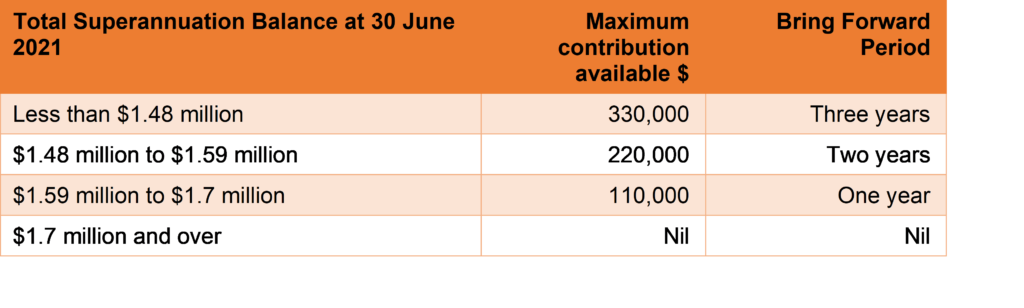
The ability to make non-concessional contributions (NCCs) into your superannuation fund is based on your age and your Total Superannuation Balance (TSB) on the preceding 30 June. Where your TSB (which is generally your total balance in superannuation) exceeds the general transfer balance cap you are unable to make NCCs without having an excess. The general transfer balance cap will increase to $1.7 million from 1 July 2021, as noted above.
In addition, the general annual concessional contribution cap will increase from $25,000 to $27,500 with effect from 1 July 2021, and as a result, the annual concessional contribution cap will increase from $100,000 to $110,000.
The current NCC caps are as follows:

The increase to the TBC will impact the NCC TSB thresholds as follows:
Planning for 2020/2021 and beyond
Planning for this year and beyond requires some consideration, particularly in light of the indexation and also where the TSB may have been impacted by COVID market value reductions.
In terms of making non-concessional contributions prior to 30 June 2021, each situation is different and there may be opportunities to maximise your contributions given the above changes and the potential changes to the contribution caps.
We can undertake a review of your situation should you wish to maximise your contributions in the short-term.
We are here to help!
As always, we are here to help, provide bespoke advice for your personal situation, and steer you safely through the maze of rules and regulations. Please call us on (08) 6311 6900 if you would like assistance with the new regime as outlined above or if you have any other superannuation queries.
This newsletter is current as of 31 March 2021, however, please note that announcements and changes are being made by the Government and the ATO regularly, and we expect that the tax and business-related responses will continue to evolve. Before acting upon the content of this newsletter, please contact us to discuss how the above applies to your specific circumstances.
Cooper Partners Financial Services, AFS License No: 327033
The information and opinions in this presentation were prepared by Cooper Partners Financial Services (“CPFS”) for general information purposes only. Case studies and examples are included for illustrative purposes only.
In preparing this newsletter CPFS has not taken into account the investment objectives, financial situation and particular needs of any particular investor. The information contained herein does not constitute advice nor the promotion of any particular course of action or strategy and you should not rely on any material in this presentation to make (or refrain from making) any decision or take (or refrain from making) any action. The financial instruments, services or strategies discussed in this publication may not be suitable for all investors and investors must make their own investment decisions using their own independent advisors as they believe necessary and based upon their specific financial situations and investment objectives.
This information is general advice only and neither purports, nor is intended to be advice on any particular matter.
No responsibility can be accepted for those who act on the contents of this publication without first contacting us and obtaining specific advice.
For further information please refer to our privacy policy


 Level 15, London House, 216 St Georges Terrace Perth WA 6000

 08 6311 6900


