
17 May 2021
INDIVIDUALS
Low and middle income tax offset extended for another year.
The amount that can be released from a first home super saver for a first home buyer rises to $50,000.
An Australian tax resident will be amended to be a person who spends 183 days in Australia in a financial year.
SUPERANNUATION
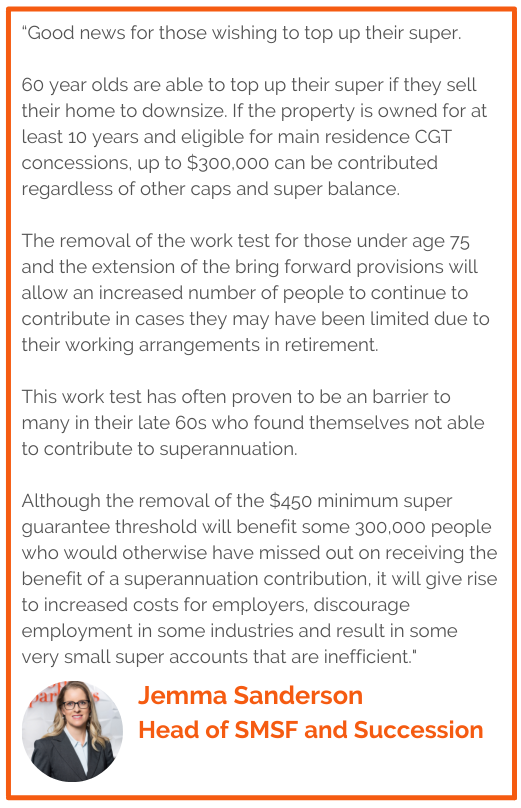
The ability to put up to $300,000 into superannuation has been extended to people aged 60 and over who downsize their house that they have lived in for at least 10 years.
The Work Test will be abolished for non-concessional and salary sacrifice superannuation contributions made by people aged 67 to 74 years.
BUSINESSES
The Instant Asset Write Off of any eligible asset purchased has been extended until 30th June 2023.
The Superannuation Guarantee Levy will be altered by removing the $450 per month minimum wages payment before superannuation is payable from 1 July 2022.
$15.5 million boost for programs which encourage people to start their own businesses.
The previously announced tax rate cut for companies to 25% from 1 July 2021 will continue to be implemented.
Expansion of the SME Loan Guarantee via the provision of government guarantees to lenders. Eligible SMEs can access loans of up to $5 million for a 10-year term.
CORPORATES
From 1 July 2021, the company tax rate for “base rate” companies will reduce from 26% to 25%.
Loss Carry Back offset against prior profits made in, or after, the 2018/19 financial year has been extended to 30th June 2023.
Introduction of a “Patent Box” for Australian developed products relating to medical and biotechnology. Companies which have registered Australian patents will be eligible for a reduced taxation rate of 17% on the profits generated from these patents.
The employee share scheme legislation will be amended to remove “Cessation of Employment” as a taxing point in an attempt to make the scheme more attractive to companies and potential employees.
Individual Taxation
Tax Residency
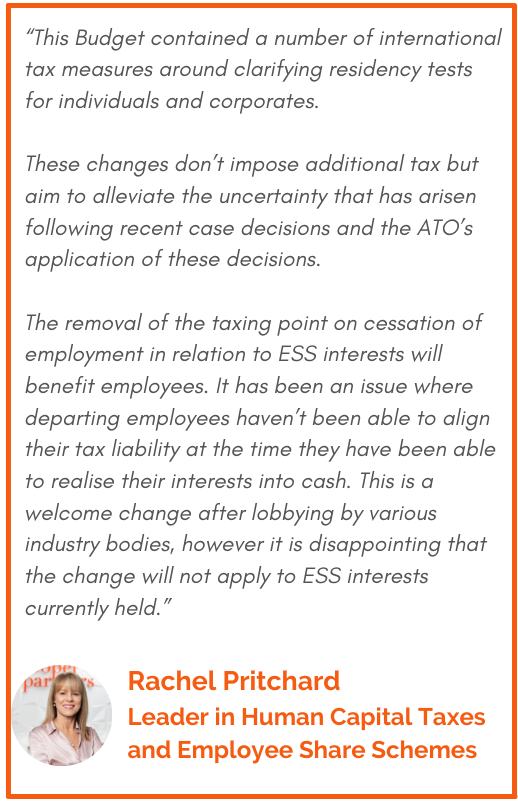
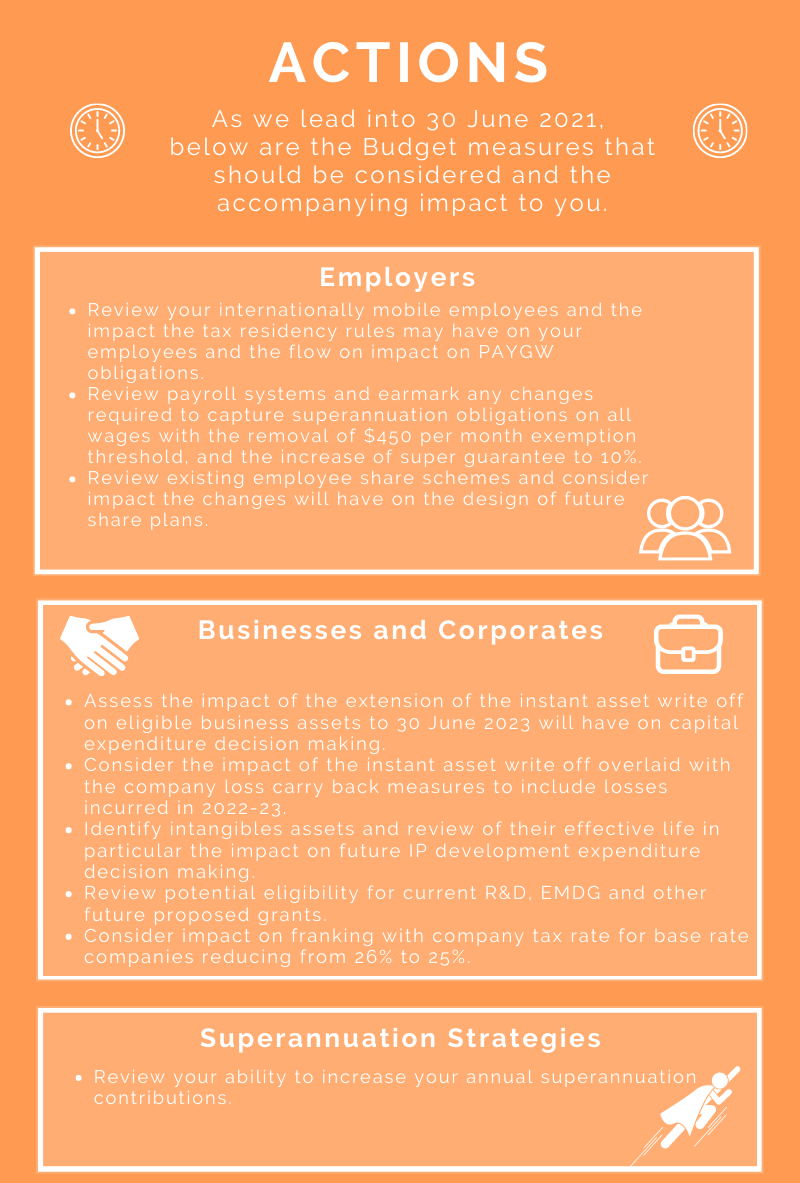
Given our global workforce (although less mobile at present), the individual tax residency rules are to be simplified, including a ‘bright line’ test where presence in Australia for 183 days or more in any income year will make you an Australian resident for tax purposes. This will be an area of caution going forward, the secondary residency tests may still apply where individuals are in Australia less than 183 days.
The new rules are to be based on recommendations outlined by the Board of Taxation in its March 2010 report to Government regarding reforming the tax residency rules. Based on these recommendations, these secondary tests may include a “commencing residency test” and a “ceasing residency test” based on a 45 day test period in Australia, together with measurable objective criteria.
The new rules will apply from the first income year after the legislation receives Royal Assent.
The current rules which are used to determine an individual’s tax residency in Australia create significant uncertainty and compliance cost for taxpayers, as is obvious from the number of recent court cases on the matter.
Tax Rates
Low to middle income taxpayers will enjoy another year of the tax offset of up to $1,080 for individuals or $2,160 for dual income/working couples. You receive this after you lodge your respective 2021 and 2022 tax returns.
Everyone loves a tax cut! Although the Budget itself did not announce new tax cuts for individuals, having already brought forward the Stage 2 tax rates to 1 July 2020 in the October 2020 Budget, there are the Stage 3 tax cuts still to come to commence from 1 July 2024.
Home Buyers
The HomeBuilder program will be extended, such that the construction commencement period will be increased to 18 months for existing applicants, with the intention that it will smooth out the construction activity in 2021 and 2022.
We have all witnessed the significant and immediate impact on the level of building activity from this incentive, which has subsequently put pressure on costs of construction and access to trades, due to the timeframes put on the original HomeBuilder scheme, which had previously been extended to 6 months from the initial 3 months to commence construction after signing of the contract.
This is a welcome announcement to ease the pressure on builders, and may also result in a reduction in costs for many who took advantage of the scheme, where the incentive itself may have been lost due to the escalated pricing flowing from the limited access to trades. This scheme is expected to support over $30 billion in residential construction activity.
The Government will provide a further 10,000 places under the New Home Guarantee, which provides a guarantee for first home buyers with as little as a 5% deposit.
Further, up to 10,000 single parents with dependents are eligible for a Family Home Loan Guarantee to enter (or re-enter) the home ownership market, where they may be able to purchase a property with as little as a 2% deposit, subject to servicing requirements.
The First Home Super Saver Scheme will be extended from 1 July 2022 to allow the maximum amount of contributions to superannuation to be released to increase from $30,000 to $50,000. We can see this could be of interest to parents wanting to assist their children in funding their entry into buying their first home.
Childcare
An additional $1.7 billion will be directed to child care support to increase the subsidy for the second and subsequent children, and also removing the annual cap (currently at $10,560 per child). These new measures would apply from 1 July 2022.
This is a welcome change, as the cost of child care can be prohibitive for the primary caregiver to return to work.
Self-education expenses
The current non-deductibility of the first $250 of eligible self-education expenses will be removed from the financial year commencing after Royal Assent.
Business Taxation
Tax rates
The previously announced tax rate cut for companies to 25% from 1 July 2021 will continue to be implemented. As with the previous reductions from 1 July 2015, it will be important to consider the impact that this reduction will have on dividends and franking credits within those businesses, making tax planning for 2021 important where the current tax rate is 26%, and therefore the franking credits are at 26% to be reduced to 25% as of 1 July 2021.
SME Recovery Loan Scheme
Continuing to support the SME recovery loan scheme for those businesses who received JobKeeper in March 2021, whereby lenders are providing cheaper credit.
The scheme applies to eligible SMEs as follows;
- up to $5m for a term of up to 10 years.
- interest rates capped at 7.5%.
- permitted use of the loans for a broad range of business purposes
- lenders can offer borrowers a repayment pause of up to two years.
Debt Recovery
Providing an intermediary between the ATO and small businesses with respect to tax debts through the Administrative Appeals Tribunal.
Further to the insolvency reform measures announced in October 2020, the Government announced that they will undertake further consultation to clarify the treatment of trusts with corporate trustees, which currently fall outside the corporate insolvency regime, and improving scheme of arrangement processes to better support business.
The minimum threshold at which creditors can issue a statutory demand on a company will increase from $2,000 to $4,000.
SG Minimum Income Threshold
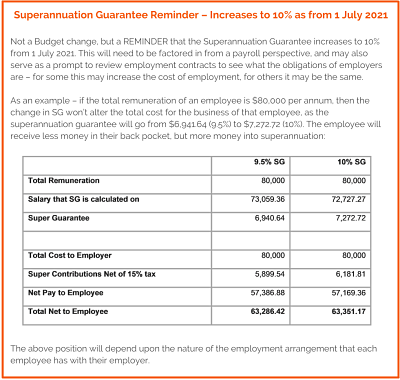
The $450 per month minimum income threshold for the superannuation guarantee will be removed. This means that employers will have to pay the superannuation guarantee for employees from the first $1 earned from 1 July 2022.
Instant Asset Write Off
Extending the temporary full expensing measure (the ability to claim an upfront deduction for equipment in the year of acquisition) until 30 June 2023. This applies to businesses with an aggregated turnover of up to $5 billion. The asset must be installed ready for use by 30 June 2023. This will enable businesses to have a medium to long term view on their capital expenses in this regard, and not feel the pressure of supply delays in the shorter term.
Corporate Taxation
Temporary loss carry-back
Extended for another year until 2022/2023, which allows companies with profits from 2018/2019 to carry back current year losses and claim back the tax paid in the previous years. This assists cashflow for businesses, encourages investment back into their business, which creates jobs, whilst complementing the extension of the temporary full expensing measures.
Tax Residency
Consulting on the simplification of the corporate tax residency provisions as previously announced, including consultation on broadening amendments to trusts and corporate limited partnerships.
Employee Share Schemes
Changing the Employee Share Scheme (ESS) rules to remove the taxing point for employees that occurs on cessation of employment in relation to ESS interests issued from 1 July 2021 after the measures receive Royal Assent.
This measure will have the effect of pushing back the deferred taxing point to the earliest occurrence:
- for shares – when there is no real risk of forfeiture and no restrictions on disposal.
- for options – when the option is exercised by the employee, when there is no real risk of forfeiting the resulting share and no restrictions of disposal.
- after a maximum deferral period of 15 years.
Administration will also be eased in relation to ESS plans by:
- removing disclosure requirements where the employer does not charge or lend to participating employees;
- increasing the per employee cap from $5,000 to $30,000 per year for ESS interests issued by unlisted companies where companies charge or lend for issuing employee shares;
- increasing the value of shares that can be issued to employees utilising the simplified disclosure requirements.
Innovation
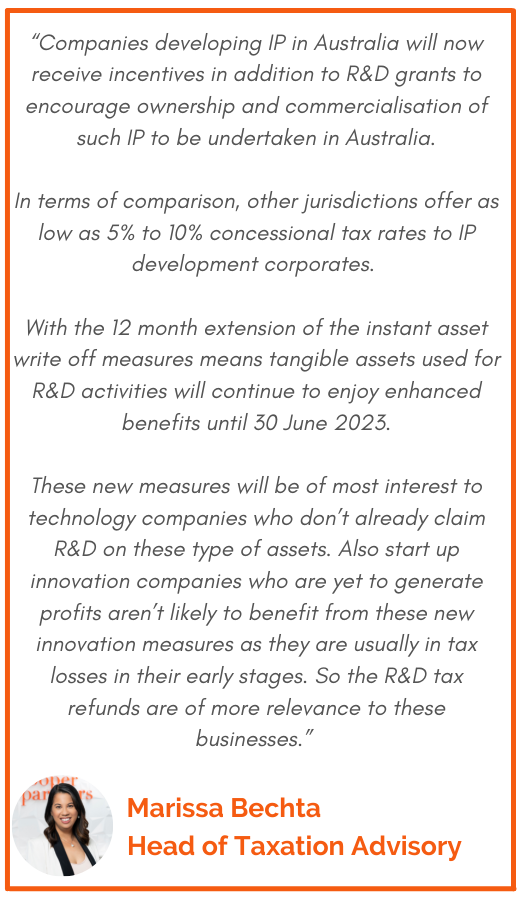
Introducing a Patent Box from 1 July 2022 to encourage innovation, through a concessional corporate tax rate of 17% initially targeted towards Australian medical and biotech industries to be potentially extended to the clean energy sector.
Incentives to eligible Australian games developers to receive a tax offset of 30% from 1 July 2022.
Ability to self-assess the effective life of intangible assets like patents, designs, copyrights, IP and in-house software, with the ability to bring forward depreciation deductions compared to the current statutory depreciation rates.
This measure will apply to new assets from 1 July 2023, following the end of the temporary full expensing regime.
Mining
The Government has announced an extension to the Junior Mining Exploration Incentive (JMEI) program for another four years. Under the JMEI program, eligible companies are able to create exploration credits by forgoing a portion of their tax losses that relate to greenfield exploration expenditure and distribute the credits to their new investors as franking credits to corporate investors and refundable tax offset all other taxpayers.
The Government will also make minor legislative amendments to allow unused exploration credits to be redistributed a year earlier than what it is currently.
Superannuation
The last few Budgets have kept superannuation on the down-low, and in this Budget there were not many measures announced, however those measures that were will have a substantial impact.
Contribution strategies
Removal of the work test from 1 July 2022 for those aged 67 to 74 for salary sacrificed contributions and non-concessional contributions. The work test will still apply for concessional contributions (those claimed as a tax deduction).
The bring forward provisions will be extended to those aged between 67 and 74, subject to the current total superannuation balance provisions. At present, you are only eligible to contribute up to $100,000 per annum (to be indexed to $110,000 per annum in 2021/2022) over that age bracket if you meet the work test. This would enable a 72 year for example to contribute $330,000 in 2022/2023 to superannuation without. having to meet a work test, provided their total superannuation balance at 30 June 2022 is less than $1.48 million.
The downsizer contributions will be extended to those who are over age 60, rather than just those over age 65 as it currently stands. This would apply from 1 July 2022.
Market linked and Complying pensions
Providing a two-year period (from 1 July after the date of Royal Assent) whereby pensioners who have a legacy pension (such as a market linked income stream, term allocated pension or complying lifetime pension) within their superannuation will be able to restructure their account to the more flexible and contemporary pension options currently available.
Importantly:
- It is not compulsory, but is an option for those eligible to consider to simplify their arrangements;
- Where such a restructure involves a reserve account, that reserve account can be allocated back to the accumulation phase and would be taxed at 15%;
- The Transfer Balance Cap provisions will have to be considered
- The impact on social security entitlements will have to be considered.
This is a measure where the devil will be in the detail, as previous measures to address these pensions in the past have had unfavourable outcomes. We have already been in discussions with members of the industry bodies with respect to the various means that this legislation could be implemented, so watch this space, as there could also be no incentive to restructure where the outcome is highly unfavourable, as it currently appears may be the case.
Super Fund residency
Amending the residency rules as they apply to SMSFs by increasing the central management and control test period to five years (currently two years), and removing the active member test. This will also apply to Small APRA Funds.
This is a great measure, as some funds inadvertently breach the active member test and there is no discretion available to rectify such a breach, and the consequences are dire for such funds. Further, it would enable people overseas who are intending to immigrate to Australia to build their superannuation through an SMSF prior to them becoming Australian tax residents. This measure would apply from 1 July after Royal Assent.
NEXT STEPS
There are a number of incentives in this Budget to keep us on the strong road to recovery as the nation navigates through the impacts of COVID on the economy. As with any reform such as this, we will be interested in the future release of the accompanying detail, and particularly with consideration of the effective dates of any measures.
We will keep you abreast of any changes as the legislation is introduced, and if you have any questions in the meantime, please contact your Cooper Partners Engagement Team.
We look forward to assisting you.
This newsletter is current as of 17 May 2021, however, please note that announcements and changes are being made by the Government and the ATO regularly, and we expect that the tax and business-related responses will continue to evolve. Before acting upon the content of this newsletter, please contact us to discuss how the above applies to your specific circumstances.
This information is general advice only and neither purports, nor is intended to be advice on any particular matter.
No responsibility can be accepted for those who act on the contents of this publication without first contacting us and obtaining specific advice.
Liability limited by a scheme approved under Professional Standards Legislation.
For further information please refer to our privacy policy


 Level 15, London House, 216 St Georges Terrace Perth WA 6000

 08 6311 6900


