
4 June 2021
As 30 June 2021 approaches, it is important to attend to the usual requirements before 30 June, but with this being a unique year where superannuation values at 30 June 2020 may have suffered a COVID decline, this could be the year where strategies become more important to implement.
This newsletter will outline:
1. Minimum Pension Payments
2. Concessional (deductible) contributions prior to 30 June 2021
3. Non-concessional contribution strategies prior to 30 June 2021 and beyond
Ensuring Minimum Pension Payments are Made
Under the government stimulus package in connection with COVID-19, the default minimum rates for pension payments were halved for the 2019/2020 and 2020/2021 financial years. As a result, the minimum pension withdrawal required decreased. The temporary rates are as follows:

To satisfy the 2020/2021 annual pension requirements, all pension payments must be withdrawn from the superannuation fund and transferred to the member’s personal bank account by 30 June 2021.
Failing to the meet the minimum pension requirements could lead to the fund losing the tax exemption with respect to the income and realised capital gains generated by the assets supporting the pension, and as a result all of the fund’s income will be subject to tax.
The Prime Minister announced on 29 May that this provision would be extended for another year, and therefore the above revised drawdown will continue to apply until 30 June 2022.
Pre 30 June 2021 considerations:
- Ensure you have paid the minimum pension amount prior to 30 June 2021. In this regard, where you intend to pay electronically, ensure that you leave plenty of time to provide instructions to your bank or investment adviser if required, to realise assets in order to pay out the pension in cash. The pension must be paid in cash.
- Members that have already paid more than the adjusted minimum pension amount (due to halving of the minimum pension rates) may consider stopping making further pension payments for the remaining period until 30 June 2021. This is to ensure that the superannuation fund is maximising its pension exemption.
- Members that have Transition to Retirement Pensions in place are subject to a 10% maximum drawdown of the pension balance at 1 July 2020 or the date the pension commenced.
Contribution Caps
Concessional Contributions
Concessional contributions include employer contributions, salary sacrifice contributions, and personal deductible contributions:
- The current limit for concessional contributions for the 2020/2021 financial year is $25,000. From 1 July 2021, this limit will be indexed to $27,500.
- Where the member is aged 66 or younger, the member can make concessional contributions without satisfying the work test.
- Members aged between 67 and 74 need to meet the work test before they can make voluntary, i.e. non-employer mandated contributions (40 hours gainful employment in 30 consecutive days) or meet the work test exemption criteria. The work test exemption criteria are:
- You have a total superannuation balance of less than $300,000 at the previous 30 June.
- You have satisfied the work test in the financial year preceding the year in which you make the contribution.
- You have not previously utilised the work test exemption.
- You are under age 75 (if you intend to make voluntary contributions).
- Members over 75 years of age can only receive employer-mandated contributions.
Carry Forward Unused Concessional Contributions
Since the 2018/2019 financial year, an individual has been able to carry forward any unused concessional contributions cap. The individual can contribute these unused amounts to superannuation, provided they have a total superannuation balance (TSB) of less than $500,000 at the commencement of the financial year in which the contribution in made.
The below table shows the operation of the carry forward unused concessional contributions in three different scenarios:

Accordingly, where an individual has not fully utilised their concessional contributions cap in the prior years since 1 July 2018, and they have less than $500,000 in superannuation at 30 June 2020, they could make a contribution of up to $75,000 in the 2020/2021 financial year. This is dependent on their contribution history.
This provision may be attractive to individuals who wish to top-up their superannuation or have made a substantial windfall gain or capital gain in the 2020/2021 financial year that they wish to manage. That is, the combination of their ability to claim a tax deduction, as well as a carry-forward amount would enable them to add to their superannuation and assist in managing their CGT position.
Non-Concessional Contributions
Non-concessional contributions include any after-tax voluntary contributions made by individuals:
- The current limit for the non-concessional contributions for the 2020/2021 financial year is $100,000. This limit will be indexed to $110,000 for the 2021/2022 financial year.
- Where the member is aged 66 or younger, the member can make non-concessional contributions without satisfying the work test.
- Where an individual is aged 64 or younger at the start of a financial year (proposed to increase to age 66 with legislation yet to pass through Parliament), the individual can bring forward up to two future years of their non-concessional contribution limit and make a contribution up to $300,000 (or $330,000 from the 2021/2022 financial year), subject to their total superannuation balance (outlined below).
- Members aged between 67 and 74 need to meet the work test before they can make voluntary contributions, i.e. non-employer mandated contributions. Further, such members can only contribute the single year contribution cap amount ($100,000 in 2020/2021).
Total Superannuation Balance and Non-Concessional Contributions
The ability for an individual to make any non-concessional contributions and utilise the bring forward provisions is dependant on their total superannuation balance (TSB) at 30 June of the prior financial year.
For the 2020/2021 financial year, the thresholds with respect to the bring forward non-concessional contribution cap are as follows:
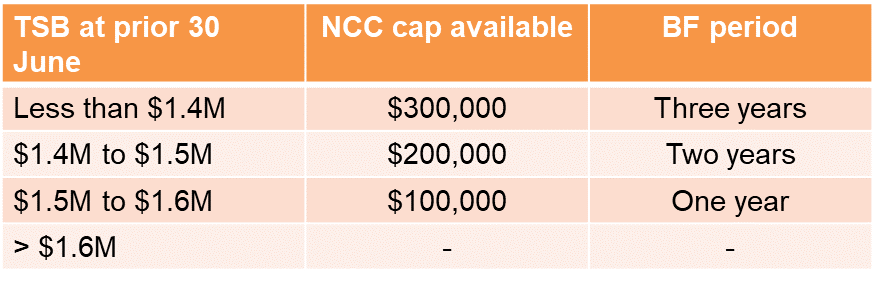
For the 2021/2022 financial year, in light of indexation, the thresholds are as follows:

Example
- 63 year old Homer has the following benefits in super at 30 June 2020:

- Homer hasn’t made any contributions over the last three years to superannuation, and has the capacity outside superannuation to make contributions.
- Given this time of the year, and the fact that Homer’s TSB at 30 June 2020 was well below $1.4 million, it might be considered appropriate for Homer to contribute as follows to maximise the amount in superannuation:
- $100,000 prior to 30 June 2021
- $330,000 in July 2021
Therefore, we would be looking to make contributions totalling $430,000 in a very short period of time.
- However, this particular year poses a few other considerations for Homer:
- The above contribution in July 2021 is on the basis that his TSB at 30 June 2021 is less than $1.48 million.
- This will be dependant on the investment performance of his benefits since 30 June 2020, taking into consideration also his pension payments from the fund, and the $100,000 contribution.
- Given the impact that COVID had on market values at 30 June 2020, it may well be the case that Homer’s superannuation benefits even after factoring in his pension payments has recovered to the point that he has more than $1.48 million in superannuation now, and then that would likely represent a balance at 30 June 2021.
- Where this is the case, and particularly if Homer’s benefits are between some of the above thresholds for contributions for 2021/2022, it may be more appropriate for Homer to make a $300,000 contribution in 2020/2021.
- Although that isn’t as much as the $430,000 above, this will ensure that he can at least increase his superannuation benefits by $300,000, and not miss out entirely on making more than a $100,000 contribution.
- Therefore, it will be important to monitor the values in Homer’s account in the lead up to 30 June 2021 to ascertain whether it is this year for a contribution or in July. It may require some last minute considerations, depending on how Homer’s investments are performing within the Fund. 2020/2021 could be the last opportunity for a substantial contribution for Homer due to TSB and bring forward provisions.
Pre 30 June 2021 considerations:
In order to maximise your contributions to superannuation prior to 30 June 2021, consider the following:
- Are you able to make concessional contributions up to your cap, or use the carry-forward concessional caps? This might include the ability to salary sacrifice an amount from your salary, or perhaps make a personal contribution and claim a deduction in your personal tax return (please note, eligibility criteria apply to personal deductible contributions).
- Do you have the capacity and available funds to make non-concessional contributions into superannuation?
- If the value of your TSB is under $1.4 million at 30 June 2020 and likely to be over $1.48 million at 30 June 2021, consider if you are able to maximise your non-concessional contributions by accessing the bring forward provisions now.
- Where you intend to make contributions electronically, ensure that you have left sufficient time for the contribution to be cleared into the fund’s bank account. It is the time that the superannuation fund receives the contribution that is the relevant date for the fund, not the time that it leaves your bank account.
Withdrawal and Recontribution
A withdrawal and recontribution strategy can be incredibly beneficial for both the member and their children. It involves the withdrawal of benefits from superannuation that comprise taxable components and (more often than not) some tax-free components in proportion to the components of the benefit, and the subsequent contribution of the amount withdrawn as a non-concessional contribution, thereby being classified as a tax-free component.
A withdrawal and recontribution strategy can have the following benefits:
- The tax-free component arising from the non-concessional contribution is tax-free when paid to beneficiaries that are not tax dependants (such as adult children).
- The withdrawal and recontribution strategy can assist in hedging against any future legislative risk of the introduction of taxing superannuation fund income stream payments after the age of 60.
- The withdrawal and recontribution strategy provides a mechanism for couples to equalise their superannuation benefits to then allow for a larger portion of their combined benefits to be in retirement phase where the income would be tax exempted.
Pre 30 June 2021 considerations:
Where the above position similar to Homer is the case, whereby your TSB at 30 June 2020 is under $1.4 million, however there isn’t the available assets outside superannuation to top-up with contributions (generally the preference – to build assets within superannuation from resources outside), adopting a withdrawal and recontribution strategy prior to 30 June 2021 for the above benefits may be appropriate.
The Next Steps
This is a unique year where the implementation of some strategies may only be able to be achieved prior to 30 June 2021 due to the recovery of asset values post 30 June 2020. Therefore, it is worthwhile reviewing your position if you may be close to the relevant thresholds. If you would like further details or assistance with respect to any of the above strategies, superannuation in general, or wish to have your position reviewed in light of the above, please contact our office on 08 6311 6900.
This newsletter is current as of 4 June 2021, however, please note that announcements and changes are being made by the Government and the ATO regularly, and we expect that the tax and business-related responses will continue to evolve. Before acting upon the content of this newsletter, please contact us to discuss how the above applies to your specific circumstances.
Cooper Partners Financial Services Pty Ltd AFSL 000 327 033
The information and opinions in this presentation were prepared by Cooper Partners Financial Services (“CPFS”) for general information purposes only. Case studies and examples are included for illustrative purposes only.
In preparing this newsletter CPFS has not taken into account the investment objectives, financial situation and particular needs of any particular investor. The information contained herein does not constitute advice nor the promotion of any particular course of action or strategy and you should not rely on any material in this presentation to make (or refrain from making) any decision or take (or refrain from making) any action. The financial instruments, services or strategies discussed in this publication may not be suitable for all investors and investors must make their own investment decisions using their own independent advisors as they believe necessary and based upon their specific financial situations and investment objectives.
This information is general advice only and neither purports, nor is intended to be advice on any particular matter.
No responsibility can be accepted for those who act on the contents of this publication without first contacting us and obtaining specific advice.
Liability limited by a scheme approved under Professional Standards Legislation.
For further information please refer to our privacy policy


 Level 15, London House, 216 St Georges Terrace Perth WA 6000

 08 6311 6900


