
24 June 2021
On 17 June 2021, the Parliament passed new legislation in relation to superannuation which will bring about changes to member limits in SMSFs and contributions. These new rules received Royal Assent on 22 June 2021, and three of the four measures are effective from 1 July 2021.
The changes that this new legislation impacts are:
- The introduction of six-member SMSFs
- The extension of the bring forward non-concessional contributions to those aged up to 67
- Removal of excess concessional contribution charge
- Recontribution of COVID-19 early release amounts
Six-member SMSFs
Currently, SMSFs are limited to a maximum of four members.
SMSFs have often been used by families to have control over their superannuation and the investment of their superannuation monies. For families with more than four members, where the intention is to have all family members involved in an SMSF, to have everyone involved in an SMSF would require the creation of multiple SMSFs. This increases administration costs, or prompt the use of a large / public offer superannuation fund.
Under the new rules, the member limit in SMSFs will be increased to six members. This will provide flexibility for larger families to include more members into a single SMSF.
As part of the new rules introduced, where there are more than two members in an SMSF, at least half of the directors of the corporate trustee or individual trustees (it is not recommended to have individual trustees within an SMSF) are required to sign the annual SMSF financial statements. For example, where an SMSF has five members who are also directors of the corporate trustee, at least three directors of the corporate trustee will need to sign the annual SMSF financial statements.
Prior to adding additional members, there are a few areas of consideration:
- The trustee(s) should review the SMSF trust deed to ensure that the deed permits more than four members. Where the deed does not permit more than four members, an update to the deed should be considered.
- State legislation may prohibit trusts from having more than four individual trustees. SMSFs are subject to this legislation as well. SMSFs with individual trustees therefore need to check their state legislation and if necessary implement a corporate trustee structure in order to make use of the six-member limit. As noted above, it is not recommended to have individual trustees within an SMSF.
Extension to bring forward non-concessional contributions
Previously, only members under age 65 at 1 July of the relevant year were able make non-concessional contributions of up to $300,000 (subject to meeting other criteria) by bringing forward up to two years of non-concessional contributions cap in a year. Members age 65 and over at 1 July of the relevant year were not able to access the bring forward provisions.
Under the new rules, the bring forward provisions will be extended to members aged 65 and 66 at 1 July of the relevant financial year. This provision is effective from 1 July 2020, which means that THERE IS AN OPPORTUNITY NOW BEFORE 30 JUNE 2021 for those who were 65 or 66 at 1 July 2020, where the other eligibility criteria are met (outlined below).
As the 2021/2022 federal Budget announced an extension to the bring forward provisions from 1 July 2022 for members up to age 74, this is an opportunity prior to that time for those eligible to top-up their superannuation.
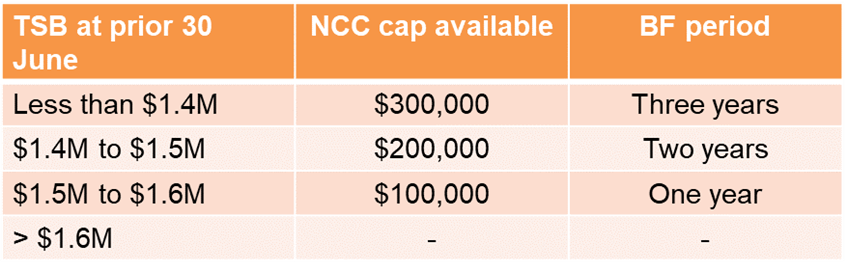
As explained in our previous newsletter, the ability for an individual to make non-concessional contributions (NCCs) and utilise the bring forward provisions is dependent on their total superannuation balance (TSB) at 30 June of the prior financial year.
For the 2020/2021 financial year, the thresholds with respect to the bring forward non-concessional contribution cap are as follows:
For the 2021/2022 financial year, the thresholds will be indexed as follows:

Removal of excess concessional contribution charge
Currently, a charge applies on the income tax payable on excess concessional contributions over the annual cap to account for the delayed collection of income tax on the excess concessional contributions.
Under the new legislation, the excess concessional contribution charge will be removed on excess concessional contributions from 1 July 2021.
Recontribution of COVID-19 early release amounts
From 20 April 2020 to 31 December 2020, members who were adversely financially affected by COVID-19 were able to apply for early access to superannuation, being $10,000 in the 2019/2020 year and $10,000 in the 2020/2021 year.
Under the new legislation, members who had withdrawn COVID-19 early release amounts are able to recontribute the amounts withdrawn back into superannuation between 1 July 2021 and 30 June 2030 without it counting towards contribution caps. However, the recontribution cannot be deducted from the member’s personal assessable income.
This new avenue for contributions may assist members who were adversely financially affected by COVID-19 to rebuild their superannuation.
The Next Steps
If you would like further details or assistance with respect to any of the above changes, superannuation in general, or wish to have your position reviewed in light of the above, please contact our office on 08 6311 6900.
This newsletter is current as of 24 June 2021, however, please note that announcements and changes are being made by the Government and the ATO regularly, and we expect that the tax and business-related responses will continue to evolve. Before acting upon the content of this newsletter, please contact us to discuss how the above applies to your specific circumstances.
Cooper Partners Financial Services Pty Ltd AFSL 000 327 033
The information and opinions in this presentation were prepared by Cooper Partners Financial Services (“CPFS”) for general information purposes only. Case studies and examples are included for illustrative purposes only.
In preparing this newsletter CPFS has not taken into account the investment objectives, financial situation and particular needs of any particular investor. The information contained herein does not constitute advice nor the promotion of any particular course of action or strategy and you should not rely on any material in this presentation to make (or refrain from making) any decision or take (or refrain from making) any action. The financial instruments, services or strategies discussed in this publication may not be suitable for all investors and investors must make their own investment decisions using their own independent advisors as they believe necessary and based upon their specific financial situations and investment objectives.
This information is general advice only and neither purports, nor is intended to be advice on any particular matter.
No responsibility can be accepted for those who act on the contents of this publication without first contacting us and obtaining specific advice.
Liability limited by a scheme approved under Professional Standards Legislation.
For further information please refer to our privacy policy


 Level 15, London House, 216 St Georges Terrace Perth WA 6000

 08 6311 6900


